The Three-Mile Limit: North Devon's Farm-Scale Biogas Plants and the Grid That Won't Take the Power
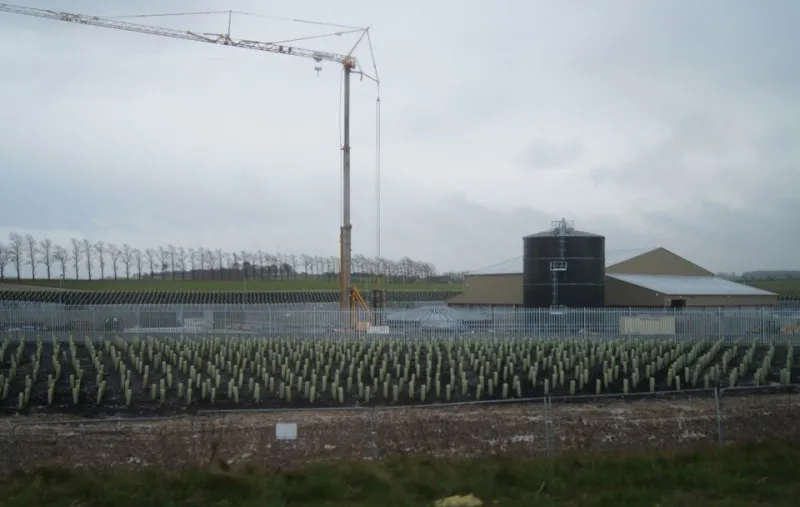
Photo: Fernweh , CC BY-SA 2.0, via Wikimedia Commons
On a farm a few miles outside Holsworthy, the most conspicuous piece of climate infrastructure is a green dome the size of a modest barn, sitting behind a hedge and a line of wind-bent sycamores. It receives, most days, several tanker loads of slurry from the dairy herd, along with whatever crop waste the neighbouring holdings cannot use. What emerges is a gas that either drives a small engine or is cleaned and sent into the gas network, and a liquid that goes back onto the fields.
There are perhaps a dozen schemes like it across northern Devon, mostly small by industry standards, and collectively they represent one of the more practical answers to a stubborn regional question: what do you do with the slurry from a pastoral dairy economy that has nowhere to spread it in the winter and no cheap way to move it very far?
Anaerobic digestion is not new here. What is new is the squeeze. Support mechanisms have narrowed, feedstock markets have tightened, and the electricity distribution network in this corner of Devon has less spare capacity than the brochure photographs of digesters tend to suggest.
What the plants actually do, and what they do not
It is worth being precise about the technology, because the claims made for it sometimes outrun it. A sealed vessel holds slurry and other organic material in the absence of oxygen; bacteria break it down, releasing a mixture of methane and carbon dioxide. That biogas can be burned in a combined heat and power unit to make electricity and heat, or upgraded to biomethane and injected into the gas grid.
The residue, digestate, retains much of the nitrogen and phosphorus from the inputs in a more plant-available form. That is the part most farmers talk about first, and with good reason: slurry storage rules have tightened, and the pressure on nutrient management planning in catchments feeding the Taw and Torridge has not eased.
A single 250-kilowatt plant will not decarbonise a supply chain. It will, if run sensibly, reduce a farm's exposure to fertiliser prices, cut the volume of raw slurry going into a lagoon, and provide a modest income stream.
Feedstock: the quiet squeeze
Where these schemes run into difficulty is on the input side. Dairy slurry is cheap but low-yielding; the gas comes from the more energy-dense material, which in practice means maize, wholecrop, or the food-processing residues that once underwrote the sector's economics.
Maize is now contested ground. The same acreage that feeds a digester could grow grass for a herd, and in a region where the cost of purchased feed and the value of pasture are both moving, the opportunity cost becomes visible. Processors' waste is finite and increasingly traded nationally, with haulage quickly eroding the margin on anything more than a short trip.
Operators interviewed for this piece consistently described the same problem in different words: the plant only works at scale of throughput, and the feedstock available within an economic radius of the gate is not always sufficient to reach it.
The substation problem
Then there is the connection. Several of the smaller schemes in the area export electricity to the local distribution network, and the relevant substations have limited headroom. In some cases a plant has been built to a size it can export, rather than a size it could run, because the network operator could not offer more.
National Grid Electricity Distribution's South West licence area has seen a substantial queue of connection applications in recent years, much of it solar and storage. Ofgem's reforms to the connection process aim to clear speculative applications and prioritise projects that are ready to build, but the practical effect for a farm-scale digester in a rural part of Torridge is that the answer is often a date several years out, or an offer with a curtailment condition attached.
Flexible connections, under which a generator accepts being curtailed at times of constraint, have become more common. For a digester the calculation is awkward: biological processes do not throttle neatly to a schedule, and gas storage costs money.
Digestate, nutrients and the honest accounting
Digestate is where the environmental case is strongest and also where it is easiest to overstate. The material is not a waste; it is a fertiliser substitute, and its value depends entirely on how and where it is spread. Applied at the wrong rate, in the wrong month, on ground already rich in phosphorus, it is a nutrient problem wearing a green jacket.
Good practice requires soil testing, nutrient budgets and adequate storage. Under the strengthened slurry storage requirements in England, many holdings have had to invest in covered stores and greater capacity, which has incidentally made the slurry fraction more attractive to digester operators: a well-covered store keeps the methane in the tank rather than the atmosphere.
The methane question
Any serious assessment of anaerobic digestion has to acknowledge that methane is a potent greenhouse gas, and small plants are not exempt from leaks. Fugitive emissions from pressure relief valves, pipework and digestate storage are the difference between a scheme that delivers a genuine saving and one that largely rearranges the problem. Operators in the region generally welcome tighter monitoring rules; the difficulty is that instrumentation costs money that small plants do not always have.
What would change the arithmetic
Three things would materially improve the prospects for North Devon's digesters in the near term. The first is certainty on support: tariff-based schemes have a finite life, and the market for biomethane certificates, while real, is volatile enough that few lenders will underwrite a plant against it alone. The second is pragmatic grid access, including clearer routes for small generators to share capacity. The third is regional coordination on feedstock, so that slurry, crop residues and processing waste are matched to plants rather than hauled past one another on the A39.
None of this would transform the South West's energy system. Northern Devon's digesters are a modest contributor to a national gas grid, and a modest contributor to a regional electricity network. But they are a test case for something larger: whether small, farm-anchored energy infrastructure can be made financially durable without a permanent subsidy, and whether the rural network can accommodate the generation it has spent a decade encouraging.
In 2026, the answer is not yet clear. The domes are still producing. Whether they will still be doing so in a decade depends less on biology than on tariffs, wires and the price of maize.