Reef, Rack and Rope: Mapping the Fal Estuary’s Native Oyster Compromise
The Fal estuary has always been a place of overlapping claims. Sailing craft thread through Carrick Roads, yachts moor off Mylor and St Mawes, ferries cross to Falmouth, and shellfish businesses work the creeks and channels that make this one of the South West’s most sheltered and productive water bodies. Now a quieter claim is being staked on the riverbed: native oyster restoration, moving from experimental plots towards something more permanent.
The ambition is not controversial in principle. Native oysters, Ostrea edulis, were once abundant around the British coast, forming reef structures that supported biodiversity and fisheries alike. Their collapse over the past century and a half is a familiar story of overharvesting, disease, habitat loss and poor water quality. Restoration practitioners across Europe have spent recent years testing how to bring them back. In the Fal, those trials are beginning to raise questions that go beyond biology: who gets space in a working estuary, on what terms, and with what evidence that a restored reef and a commercial shellfish sector can thrive side by side.
A reef in a working estuary
Native oyster restoration is not simply a matter of tipping shells into the water. Practitioners need suitable substrate, careful site selection, disease screening, and enough broodstock to give a population a chance of self-sustaining recruitment. They also need time. Native oysters are slow-growing and vulnerable in their early stages, and a reef that looks promising in year one may fail by year three if conditions are wrong.
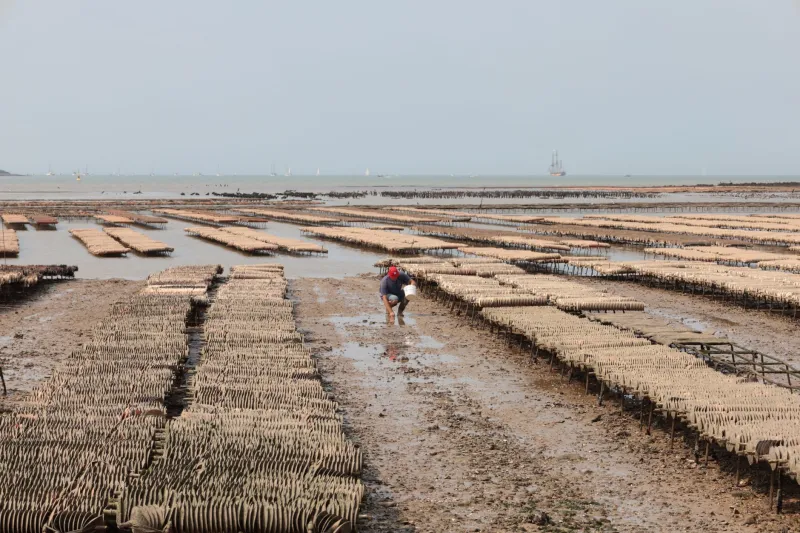
The Fal offers attractive conditions: sheltered water, strong tidal exchange, and a long history of oyster fishing and cultivation. It also offers competition for precisely the same sheltered, well-flushed ground that shellfish farmers value. Pacific oysters, mussels and other cultivated species occupy leases and racks in the estuary. Those businesses are not incidental to the landscape. They are part of the working estuary economy that restoration is meant to sit alongside, not replace.
That is where the phrase ‘oyster lease’ becomes more than an administrative term. A lease is a legal claim on the seabed, but it is also a claim on the estuary’s social and economic geography. Restoration groups may seek consent for restoration plots, while farmers hold existing several orders or leases. Regulators must decide whether those claims are compatible, complementary or in direct competition.
The claims on the riverbed
Conservationists argue that native oyster restoration should be treated as a public good, not a private hobby. A restored reef could improve water clarity through filtration, create complex habitat for fish and invertebrates, and support a native species whose decline is part of a wider loss of estuarine biodiversity. Those benefits are diffuse and long-term, which makes them easy to overlook in a lease-by-lease system geared towards extractive or cultivated use.
Shellfish farmers, meanwhile, point out that they have invested in the estuary for years. Their businesses depend on water quality, reliable classification zones and access to sheltered ground. They are also exposed to risks that restoration trials can bring: changes in how the water body is managed, new restrictions on activity, or simply the uncertainty that comes when regulators are asked to balance a new conservation objective against an existing commercial one.
The fairest way to read the debate is not as conservation versus commerce. It is as a question of carrying capacity in the broadest sense. The Fal can support a certain amount of shellfish activity, a certain amount of restoration, and a certain amount of recreational and navigational use. None of those figures is fixed. All of them depend on evidence, regulation and trust.
Water quality and the limits of restoration
Native oyster restoration is often presented as a water-quality intervention. Oysters filter plankton and suspended sediment, and dense reefs can influence local turbidity. But restoration cannot substitute for catchment management. The Fal receives nutrient and sediment inputs from agriculture, wastewater and development, and those pressures affect the estuary as a whole. A reef may help at the margins, but it will not make poor water quality disappear.
That matters for shellfish farmers because they are already on the front line of water-quality classification. A restoration scheme that improves local conditions could be welcome. A scheme that attracts new regulatory attention to the estuary, or that complicates the monitoring regime, may be viewed more cautiously. The two communities share an interest in cleaner water, but they do not necessarily share the same timetable or the same metrics of success.
Regulation, evidence and trust
The regulatory landscape is crowded. Cornwall Inshore Fisheries and Conservation Authority has a role in fisheries management. Natural England oversees protected sites, including the Fal and Helford Special Area of Conservation. The Environment Agency and Cornwall Council have responsibilities for water quality and consenting. The Marine Management Organisation may be involved in licensing. Restoration practitioners must navigate all of this while trying to deliver a project that is, by its nature, experimental.
That is not a reason to avoid restoration. It is a reason to be honest about what trials can prove and when. A small plot that shows good survival does not automatically justify a large-scale reef. A commercial shellfish operation that reports no interference from a nearby trial does not prove that interference will never occur. Adaptive management, with clear monitoring and agreed triggers for changing course, is the only credible way forward.
What coexistence would require
If the Fal is to host both a restored native oyster reef and a working shellfish sector, several things need to be true. First, site selection must be transparent, with evidence on currents, substrate, disease risk and existing uses published in a form that communities can scrutinise. Second, monitoring must include commercial and social indicators, not just ecological ones. Third, regulators need to say plainly how they will handle disputes over space, rather than leaving them to be resolved project by project.
There is also a cultural question. Native oyster restoration carries a story of return, and stories of return can unintentionally imply that the estuary should be restored to a past state in which commercial shellfish farming played little or no part. That would be a mistake. The Fal’s working character is part of what makes it worth restoring. The task is not to remove the racks and ropes, but to decide where a reef can sit among them.
A test case for the South West
The Fal is not the only estuary facing this question. Across the South West, from the Tamar to the Exe, restoration ambitions are meeting the realities of working waters. The region’s coast and estuaries are not blank slates. They are places where people earn a living, where communities have long relationships with the water, and where conservation must be negotiated rather than imposed.
That makes the Fal a test case worth watching. If native oyster restoration can be planned with shellfish farmers rather than around them, it will offer a model for other estuaries. If it cannot, the result will be a familiar one: a well-intentioned project that wins ecological headlines while losing the local trust it needs to endure. The riverbed is finite. The question is whether the process can be generous enough to share it.