Through the Notch: Somerset’s Eel Passes Face Their Flood-Season Reckoning
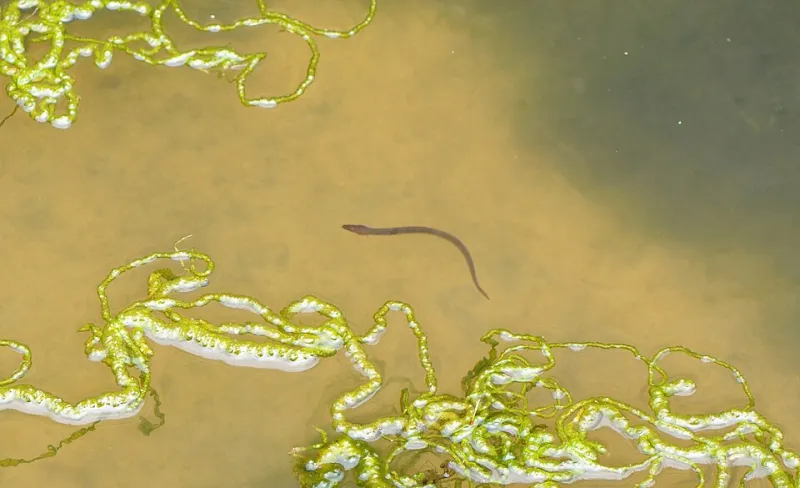
Photo: Lamiot, CC BY-SA 4.0, via Wikimedia Commons
At Burrowbridge, the Parrett is asked to do several jobs at once. It must carry winter floodwater away from low-lying farmland, keep drainage channels open through the Somerset Levels, and offer a route inland for a juvenile fish that arrives at the coast translucent, thumb-length and vulnerable to every barrier in its path. The glass eel is the first stage of the European eel’s freshwater life. By the time it becomes a pigmented elver, it may already have met a weir, a sluice, a pump or a culvert. The question for Somerset is whether the small engineering fixes now being fitted to those structures amount to a real recovery programme or a series of well-meaning interruptions.
The 2026 elver season is over, and the evidence from the Parrett and Brue catchments is mixed in the way that most environmental monitoring is mixed. Counts at some traps have held up; others have been patchy. Volunteers have spent spring evenings checking collection boxes and flow gauges. Internal drainage boards have kept their structures operating through a wet winter and a fitful spring. Conservation groups have pressed for onward passage above the first hurdle. No single number yet settles the argument.
A season measured in millimetres
Eel passage is unusual because the target species is small enough to pass through gaps that would be irrelevant to salmon or sea trout. A bristle ramp, a brush-lined tile, a narrow notch cut into a weir crest or a shallow bypass channel can all offer a route where a conventional fish pass would be over-engineered and expensive. The attraction is obvious: modest capital costs, relatively little land take and the possibility of retrofitting structures that were never designed with migration in mind.
The weakness is equally obvious. A pass that works on a clean, steady flow can fail when the river is high, when debris collects, or when a drainage board lowers levels to protect land. Glass eels are persistent, but they are not infinitely so. A bypass channel that silts up by mid-April is not a pass; it is a habitat feature with a hopeful name.
This year’s monitoring on the Parrett and its tributaries has underlined the importance of checking the whole route rather than the entrance alone. Traps below a structure can show that eels are arriving. They say much less about whether those eels can continue upstream, survive a pumped section or find the quieter water they need. In the Brue catchment, where drainage and flood storage are closely intertwined, the same lesson applies. Passage is not a point; it is a sequence.
The engineering is the easy part
The structures themselves are varied. Some schemes use eel tiles fixed to a hard bank, giving small climbers purchase on otherwise smooth surfaces. Others rely on notches that maintain a trickle of water over a weir while leaving the main flood route unchanged. Bypass channels can be designed to mimic a natural side-channel, but they need space, gradient and a water supply that does not compromise flood defence.
That last condition is where the conversation becomes difficult. The Parrett and Axe Brue internal drainage boards are not conservation bodies with a sideline in water management; they are statutory bodies responsible for keeping water levels low enough for farms, roads and settlements. A notch that is harmless in summer may need to be closed or screened when flood risk rises. A bypass channel that takes water from a drain may reduce the capacity of that drain at the wrong moment. These are not reasons to abandon eel passage. They are reasons to design it with the drainage calendar in view.
Angling interests add another layer. Coarse fisheries in the Levels have long argued for better fish passage and screening, and eels are only one part of that agenda. Some anglers regard eels as a valued native species; others worry about predation on juvenile fish in stillwaters. The practical overlap is larger than the rhetoric suggests. Screens, improved culvert design and better connection between river and floodplain can serve several species at once. But eel passage cannot be sold as a universal win if it creates new maintenance burdens for clubs and landowners without a clear funding route.
Who pays for a notch?
Capital grants are the easy money in this field. A pass can be funded as part of a flood scheme, a nature recovery project or a biodiversity obligation. Maintenance is harder. Bristle tiles collect debris. Notches need checking. Bypass channels silt. A structure that is inspected for a few seasons and then left to the landowner is not a lasting intervention.
The cost question is not trivial for small drainage boards and individual farmers. A five-figure scheme may be modest by the standards of a major flood defence, but it is not modest for a tenant farmer with a wet field and no direct income from eels. Conservation groups can help with monitoring and advocacy, but they cannot indefinitely absorb the revenue costs of keeping engineered passes clear. If eel recovery is a public good, the funding model has to reflect that, or the passes will become the aquatic equivalent of a painted cycle lane: present on the map, doubtful in practice.
There is also a risk of box-ticking. Biodiversity net gain, catchment plans and flood funding all create incentives to install features that can be counted. Counting is necessary, but it is not the same as assessing function. A pass that admits a few hundred elvers into a drain with no onward route may satisfy a condition and fail the species. The test should be catchment-scale passage, not the presence of hardware.
What would count as success?
The honest answer is that nobody yet knows what a good year looks like for eels in the Somerset Levels. European eel recruitment has collapsed since the 1980s, and recovery will not be delivered by one notch on one weir. Monitoring needs to be sustained long enough to separate weather effects from management effects. It also needs to be comparable across structures, so that a pass on the Parrett can be judged against a pass on the Brue rather than against an anecdote.
That means more than counting glass eels at the foot of a pass. It means checking above the structure, sampling for eels further upstream, recording when passes are closed or bypassed, and being honest about the sections where nothing has been done. It means involving anglers and drainage boards in the design of monitoring, not only in consultation at the start. And it means accepting that some schemes will disappoint.
The elver lift is not a single lift. It is a hundred small decisions about water levels, maintenance and money. Somerset’s weirs can learn to let eels through, but only if the people who operate them are given a reason to keep the route open after the ribbon is cut.