Spanners, Spares and Second Lives: Six Farm Repair Sheds Across the South West
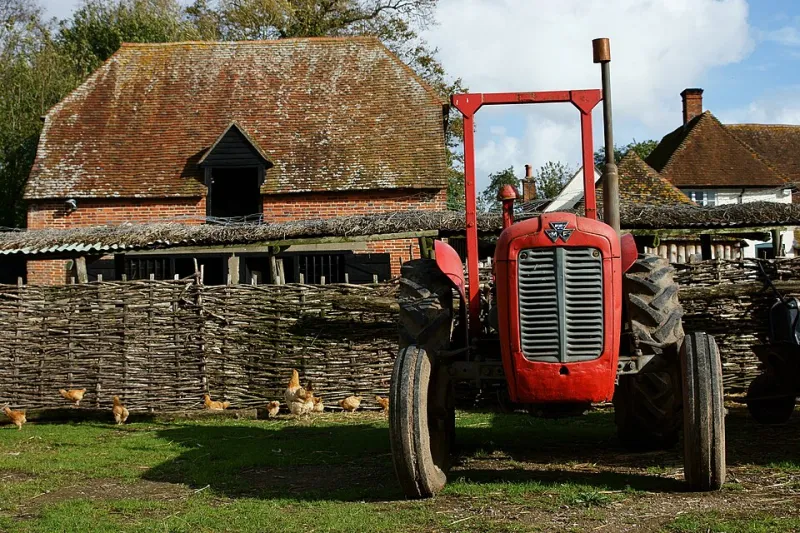
Photo: Peter Trimming , CC BY-SA 2.0, via Wikimedia Commons
On a dairy farm, a failed vacuum pump is not just a repair bill. It is a morning of lost milking, a welfare risk and a decision about whether to patch, replace or borrow. The same is true of a cracked trailer floor, a seized hydraulic valve or a hand tool that has outlived three owners. In the South West, a small network of repair sheds is trying to make that decision easier, and to keep useful metal and plastic in service for longer.
The Rural Circular Economy in Practice
Farm repair is not a new idea. What is new is the way some workshops are framing it. They are not just helping a neighbour with a welding job. They are reducing embodied carbon, cutting waste, preserving repair skills and giving farmers an alternative to a supply chain that often favours replacement. The environmental case is simple: the most sustainable tractor is usually the one already in the yard.
The six profiles below are a snapshot, not a directory. They differ in size, funding and specialism. What they share is a practical question: what would it take to keep more farm kit working for longer?
1. Tamar Tractor Shed, Tavistock
This volunteer-led shed began with a borrowed workshop and a stack of manuals. It now runs monthly repair sessions for smallholders and tenant farmers, focusing on tractors, trailers and vintage implements. The shed's strength is diagnosis: members will spend an hour tracing a wiring fault before anyone reaches for a new part. Spares come from dealer clearance stock, online auctions and a carefully labelled rack of salvaged components. The next need is lifting equipment and a covered bay so that work can continue through the wet Devon winter.
2. Exe Farm Fix-It, Exeter
Based on the edge of the city, Exe Farm Fix-It serves a mix of small dairy holdings, equestrian businesses and market gardens. Its specialism is milking equipment and stainless-steel fittings. Volunteers include a retired dairy engineer and two metalworkers who can fabricate replacement brackets that are no longer stocked. The group is experimenting with a parts-swap board so that farmers can list surplus fittings rather than buy new. Its main constraint is insurance for working on pressurised systems, which limits what it can offer beyond advice.
3. Sedgemoor Spanner Club, Bridgwater
On the Somerset levels, wet ground and heavy trailers make corrosion and structural repairs a recurring theme. The Spanner Club runs a trailer safety check alongside its repair sessions, inspecting floors, lights, brakes and couplings. It has built a useful relationship with a local agricultural dealer that passes on trade-ins with repairable components. The club would like to train more volunteers in welding and inspection, but it needs consistent funding for consumables, protective equipment and a proper record-keeping system.
4. Mendip Machinery Circle, Frome
This circle is less a workshop than a coordinated network. Members share tools, manuals and specialist knowledge across a wide rural patch. When a combine part fails in harvest, the circle can sometimes find a second-hand replacement through its contacts before a dealer can deliver a new one. The group is also building a digital register of local repair skills, from hydraulics to electronics. Its challenge is coordination: volunteers are busy, and a network only works if someone answers the phone.
5. Caradon Kit Workshop, Liskeard
Caradon Kit Workshop focuses on hand tools, small machinery and the kind of equipment that is easy to throw away and hard to replace. It repairs chainsaws, brushcutters, pumps and garden machinery, and runs short courses on basic maintenance. The workshop sources parts from manufacturer catalogues, salvage and 3D-printed replacements for simple plastic components. Its environmental contribution is measurable in avoided purchases, but its funding is not. It relies on session fees and small grants.
6. Fal Repair Barn, Penryn
Near the Fal estuary, this barn serves small farms, boatyards and horticultural businesses. It has a strong focus on hydraulic hoses, trailer components and marine-adjacent machinery, where salt corrosion is a constant. The barn is developing a parts-cleaning and testing service so that components can be reused safely rather than replaced as a precaution. It needs better extraction and waste-fluid handling to meet environmental standards, and it is looking for a partner to help with training.
What They Need to Scale
The constraints are consistent. Space, insurance, lifting equipment, diagnostic tools, consumables and volunteer time are all in short supply. Funding tends to favour new equipment rather than the unglamorous costs of safety and storage. Yet those are exactly the costs that make repair possible.
A regional support programme could help. It could provide shared insurance guidance, training in welding and hydraulics, small grants for lifting and extraction equipment, and a common parts database. It could also connect repair sheds with agricultural colleges, dealers and waste contractors. The aim would not be to create a parallel dealership network, but to make repair a normal first option.
Why It Counts as Environmental Work
Every repaired tractor avoids the embodied carbon of a new one. Every reused trailer component avoids scrap. Every litre of hydraulic oil handled correctly avoids a spill. These are modest savings individually, but they add up across a rural region with thousands of machines.
There is also a skills argument. Repair keeps practical knowledge in circulation. It gives young people a route into engineering that is rooted in real equipment. And it builds resilience: a farm that can diagnose a fault and find a part is less exposed to long lead times and price shocks.
The South West's repair sheds are not a romantic throwback. They are a working part of the rural circular economy. With the right support, they could become a more visible one.