Slow Water, Spongy Fields: Somerset’s Natural Flood Pilot Faces Its Defining Winter
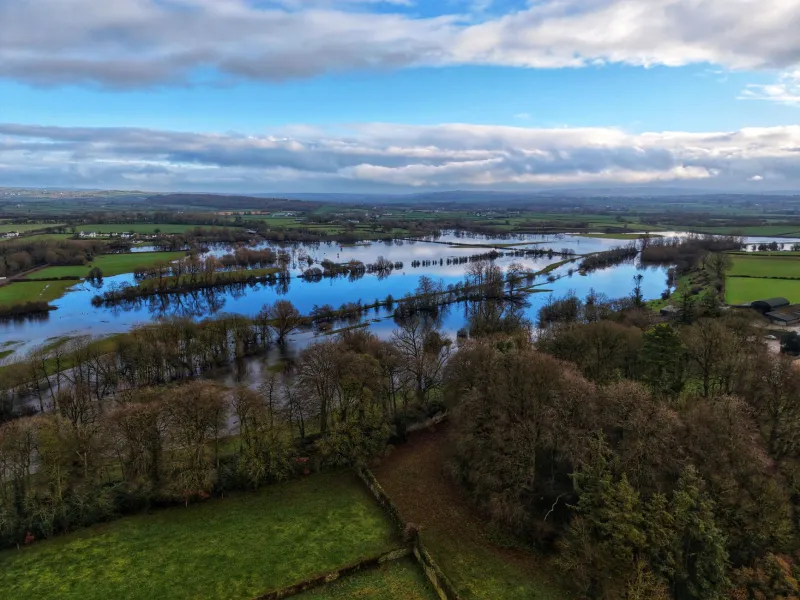
On the Somerset Levels and Moors, the autumn landscape is already telling a familiar story. Ditches run high, low-lying fields glisten after rain, and farm machinery works to a timetable set by the weather. But a pilot scheme now taking shape across a cluster of holdings is testing a different approach: paying farmers to make those wet fields work harder for flood defence. The idea is simple enough—hold water upstream in temporary wetlands, leaky dams and floodplain meadows, release it slowly, and reduce the peak that reaches towns downstream. The hard part is making it work at scale before winter 2026/27.
A landscape built to hold water
The Levels were never naturally dry. Drainage has shaped the area for centuries, and post-war improvements turned many wet meadows into productive pasture and arable land. Winter flooding is not an aberration; it is part of the system. Climate projections for the South West point to wetter winters and more intense rainfall, which puts pressure on both engineered defences and the drainage networks that keep farmland workable.
That is the context for the so-called sponge fields. The phrase is shorthand for a package of natural flood management measures: allowing water onto selected fields in winter, blocking minor drains with leaky dams, raising water tables in floodplain meadows and managing grazing so that soils retain more water. The aim is not to abandon agriculture but to vary it seasonally, using land as temporary storage while farms continue elsewhere.
How the pilot works
Participating farmers sign agreements that set out when water can be held, how long it stays and what payments follow. In practice, the measures are modest in engineering terms. A field may be allowed to flood behind a low bund or a controllable ditch structure. A minor channel may be slowed with timber or stone leaky dams. A meadow may be managed with higher winter water levels and lighter grazing in spring.
The scheme is not permanent rewilding. Most agreements allow fields to return to agricultural use once conditions permit, although the timing depends on soil type and weather. Monitoring is central: water levels, soil condition, vegetation and, where relevant, bird and invertebrate populations are recorded so that the flood storage benefit can be estimated rather than assumed.
The funding question
Who pays is the decisive issue. Public money currently comes through environmental land management schemes, local flood levy funding and catchment partnership grants. Private finance is also discussed, including biodiversity net gain and corporate sponsorship, but it remains a small share of the total. Payment rates must compete with arable and livestock margins, and they must be reliable over several years if farmers are to commit land and management time.
There is also the question of maintenance. Leaky dams need checking, ditches need managing, and monitoring has to continue after the launch photographs have been taken. If funding is short-term, the measures risk becoming a demonstration project rather than a durable part of catchment strategy.
Trade-offs on the farm
Holding water on farmland has costs. Grazing days are lost, soils can become compacted, and silt and nutrients may settle where they are not wanted. Public access and liability need careful handling where new wetlands attract visitors. Some fields are better suited than others: flat, low-lying ground with existing wet grassland is a more realistic candidate than productive arable land on higher ground.
Farmers are also wary of being asked to solve a downstream problem without a fair share of the benefit. If a town receives greater flood protection, the argument for paying upstream landowners strengthens, but the payment mechanism has to reflect the value of that service.
Downstream expectations
Towns such as Bridgwater, Taunton and Glastonbury have long relied on a mixture of engineered defences, drainage and land management. Sponge fields are not a substitute for those defences. At best, they complement them by slowing water and reducing peak flows, buying time for pumps and barriers.
The evidence base is improving but remains patchy. Catchment-scale modelling can suggest where storage will have most effect, but real-world monitoring over several winters is needed to show whether the measures perform under the sort of prolonged rainfall that causes serious flooding. That is why the coming winter matters.
The winter 2026/27 test
The pilot is now entering its decisive phase. The area involved remains modest, and scaling it up would require standard contracts, consistent monitoring, clear governance and a funding settlement that lasts longer than a single spending review. If the scheme performs well this winter, it will strengthen the case for expansion. If it struggles, the lessons will be as much about administration and farmer confidence as about hydrology.
Nature-based flood defence is not a quick fix, and the Somerset pilot should not be judged as one. Its real test is whether it can become a reliable, funded part of the region’s flood strategy—one that works for farmers, downstream residents and the wildlife that depends on wet grassland.